Google AI Overviews: Why Philippine Businesses Are Losing Clicks
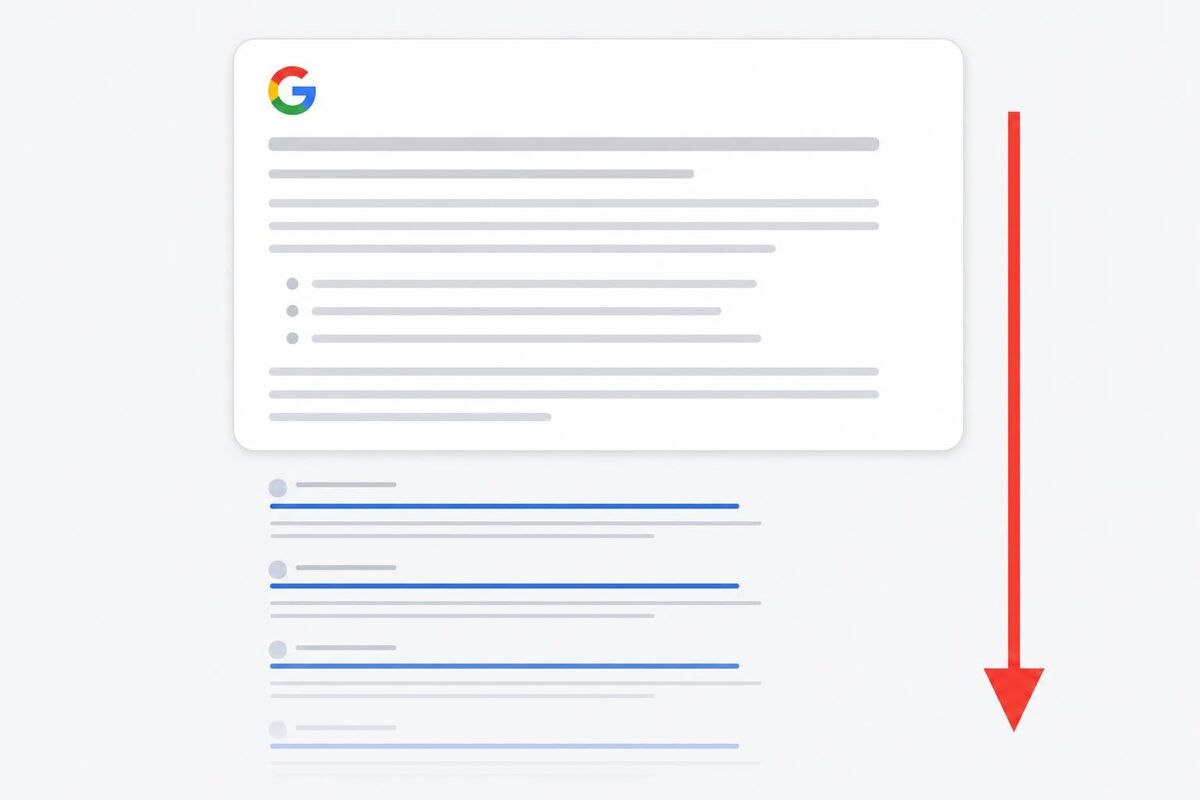
If your Google rankings have held steady but your traffic has quietly fallen, AI Overviews are the most likely explanation. Google now answers many queries directly at the top of the page, and fewer people scroll to the links underneath. This explains what changed and what a Philippine business can do about it.
What are Google AI Overviews?
AI Overviews are AI-generated summaries that sit above the normal search results. Google composes them by pulling from several web pages, then links a small number of those sources.
The practical effect: for a lot of questions, the searcher gets what they needed without clicking anything. The information still comes from your site. The visit does not.
How much traffic are they actually costing?
The clearest public measurement comes from Pew:
"Users clicked a result on 8% of visits where an AI summary appeared, compared with 15% of visits without one (Pew Research Center)."
That is roughly half the click-through rate on affected queries. Combine it with Gartner's forecast that traditional search volume drops 25% by 2026, and the direction is unmistakable: the same ranking is worth fewer visits than it was two years ago.
Two caveats worth stating plainly. Not every query triggers an Overview, and informational queries are hit hardest while commercial and navigational ones hold up better. If you sell something specific, your money queries are probably less affected than your blog traffic.
Why does this catch businesses by surprise?
Because the metric most people watch does not move. Your position stays at number three. Impressions may even rise. But clicks fall, and nothing in a rankings report explains why.
Here is how to confirm it in Google Search Console:
- Open Performance, set the range to the last 16 months
- Plot impressions and clicks together
- Look for the point where the two lines separate: impressions flat or rising while clicks decline
- Sort by query and check which ones lost clicks without losing position
That divergence is the signature. If you see it on informational queries, you are being summarised rather than visited.
What should you do about it?
Stop optimising only for the position, and start optimising to be the source inside the answer. Practically:
- Answer in the first sentence. Google lifts self-contained passages. A section that opens with three sentences of preamble gives it nothing to lift.
- Use question-shaped headings that match real queries, so the match is obvious.
- Cite specific, attributed facts. Unsupported claims get skipped because repeating them is a risk.
- Add structured data.
FAQPageandArticlemarkup make your content trivial to parse. See schema markup for AI search. - Target queries that Overviews handle badly. Anything needing local nuance, current pricing, or genuine first-hand experience still drives clicks, because a generated summary cannot substitute for it.
That last one matters most for Philippine businesses. A generic definition gets summarised away. "What does a Google Ads campaign actually cost in the Philippines in 2026" needs local specifics that a model cannot safely invent, so it still sends traffic.
Should you block Google from using your content?
Almost certainly not. You can apply nosnippet or max-snippet directives to restrict what Google displays, and that does limit Overview usage.
It also removes you from featured snippets, shortens your normal search listing, and reduces click-through on the results you still get. You would be trading a large amount of ordinary visibility to avoid a smaller amount of summarisation. For nearly every business that is a bad trade.
The better response is to be the cited source rather than the omitted one.
Is this only a Google problem?
No, and treating it as one is a mistake. The same behaviour shift is happening across ChatGPT, Perplexity, Claude and Gemini. Buyers are increasingly asking an assistant instead of a search box.
The work overlaps almost entirely. Clean structure, direct answers and verifiable facts serve Google's Overviews and every AI assistant at once. That is the argument in GEO vs SEO: same skeleton, two surfaces.
Frequently Asked Questions
What to do next
Run the Search Console check above and find out whether your clicks and impressions have actually diverged. If they have, the fix is structural rather than a matter of chasing rankings harder.
Our pillar guide to AI visibility in the Philippines covers the full playbook, or take a look at our search and AI visibility service if you would rather we ran it.
Frequently asked questions
What are Google AI Overviews?
AI Overviews are AI-generated summaries that appear above the normal search results. Google composes them from multiple web sources and links a few of them, so the searcher often gets their answer without clicking through.
Are AI Overviews reducing website traffic?
For many informational queries, yes. Pew Research Center found users clicked a result on 8% of visits where an AI summary appeared, compared with 15% of visits without one. Commercial and navigational queries are less affected so far.
Can I opt out of AI Overviews?
Not selectively. You can use the nosnippet or max-snippet robots directives to limit how much of your page Google can display, but that also removes you from featured snippets and reduces normal visibility. Most businesses should not do this.
How do I get featured inside an AI Overview?
Answer the question directly in the opening sentence of a clearly headed section, support claims with cited facts, and add structured data. Google pulls passages it can extract and attribute confidently.
Do AI Overviews appear in the Philippines?
Yes. Google has rolled AI Overviews out across many markets including the Philippines, and coverage keeps expanding to more query types.
Sources
Related reading
AI Visibility in the Philippines: How to Get Your Business Cited by ChatGPT, Perplexity and Google AI
AI visibility means getting your business cited inside AI answers. How Philippine businesses earn citations in ChatGPT, Perplexity and Google AI Overviews.
GEO vs SEO: What Actually Changes When AI Answers the Question
GEO optimises to be quoted inside AI answers. SEO optimises for a position on a results page. Here is what overlaps, what does not, and what to do first.
How to Get Your Business Cited by ChatGPT
ChatGPT cites sources it can extract and attribute with confidence. Here is the practical checklist for getting your business named in AI answers.